Chest pain centers

New symptoms? It could be your heart. Visit an Ascension Saint Thomas Chest Pain Center in Middle Tennessee.

Chest pain centers in Middle Tennessee

New symptoms? It could be your heart. Visit an Ascension Saint Thomas Chest Pain Center in Middle Tennessee.

Why choose us

If you or a loved one is experiencing chest pain, it’s important to get medical care immediately. When you choose Ascension Saint Thomas Chest Pain Centers, you get experienced heart specialists delivering a wide range of advanced heart care from diagnosis and treatment to rehabilitation.

If you need follow-up care, your doctor will work with you on a care plan and connect you to specialty heart programs including atrial fibrillation (AFib), valve and structural heart, advanced heart failure, heart transplant and more.

Understand your chest pain

Chest pain is a feeling of chest discomfort that occurs when a part of your heart doesn't get enough blood and oxygen. It is most often called angina. Angina can be a symptom of coronary artery disease (CAD), or it may be due to other causes like a heart attack.  Anything that causes your heart muscle to need more blood or oxygen can result in angina, especially if you already have a blockage or narrowing. Situations that may set off angina include:

  • Physical activity
  • Emotional stress
  • Extreme cold or heat
  • Unhealthy diet
  • Drinking too much alcohol
  • Smoking or long-term exposure to secondhand smoke.

Symptoms of chest pain

Common symptoms chest pain include:

  • A pressing, squeezing, or crushing pain, usually in the chest under your breastbone
  • Pain that may also occur in your upper back, both arms, neck, or ear lobes
  • Chest pain that spreads to your arms, shoulders, jaw, neck, or back
  • Shortness of breath
  • Weakness
  • Extreme tiredness (fatigue)
  • Feeling faint

Care teams at Ascension Saint Thomas Chest Pain Centers work closely with emergency medical services to deliver emergency heart care when and where you need it.

Know the signs of a heart attack

A heart attack doesn’t always start with severe chest pain. Some heart attacks begin suddenly, while others start with mild discomfort. Watch for these symptoms of heart attack in both men and women:

  • Chest pain
  • Discomfort or pain between the shoulder blades
  • Indigestion or gas-like pain
  • Nausea
  • Pain spreading to the shoulders, neck or arm
  • Sense of impending doom
  • Shortness of breath
  • Sweating
  • Weakness or fatigue

Ascension Saint Thomas Chest Pain Centers work closely with emergency medical services to deliver emergency heart care when and where you need it.

How we diagnose heart disease

Your doctor may recommend a series of tests to find the source of your chest pain and determine if you are having a medical emergency. You and your doctor will work together to choose a treatment option that is right for you.

A blood test is a lab analysis of things that may be found in your blood. You may have blood tests to keep track of how well you are managing a condition, such as diabetes or high cholesterol. You may also have them for routine checkups or when you are ill.

This is also known as a cardiac or heart cath. For this test, your doctor guides a small catheter (hollow tube) through the large artery in your upper leg, or sometimes your wrist or arm, into your heart. This procedure lets your doctor take a close look at the heart to identify concerns and to perform other tests or procedures.

This procedure uses a combination of large magnets, radio waves, and a computer to make detailed images of organs and structures in your body. Your doctor may order an MRI of the heart to look at the heart valves and major vessels. It can also detect coronary artery disease and how much damage it has caused. It can also assess heart problems that have been present since birth. It can find tumors and other conditions. Your doctor may order this test before other procedures such as angioplasty or stenting of the coronary arteries and heart or vascular surgery.

Your doctor may recommend this test if you have a condition that involves the blood vessels. CT angiography is a type of medical test that combines a CT scan with an injection of a special dye. This is to make pictures of blood vessels and tissues in a part of your body. The dye is injected through an IV (intravenous) line started in your arm or hand. A CT scan is a type of X-ray that uses a computer to make images of your body. The dye injected to do CT angiography is called a contrast material. This is because it highlights the blood vessels and tissues being studied.

This test records the electrical activity of the heart, shows abnormal rhythms (arrhythmias), and can sometimes detect heart muscle damage.

This is also called a treadmill or exercise ECG. This test is done to monitor the heart while you walk on a treadmill or pedal a stationary bike. Your doctor also monitors your breathing and blood pressure. A stress test may be used to detect coronary artery disease, or to determine safe levels of exercise after a heart attack or heart surgery. This test can also be done using special medicines that stress the heart in a similar manner as exercise does. Sometimes a stress test will collect ECG information along with heart ultrasound pictures. This is called an exercise or stress echocardiogram (echo). It's more sensitive and specific than ECG stress testing alone.

How we treat heart attack and CAD

Treatment for heart attack and CAD may include medication, therapy or surgery.

A coronary angioplasty is a procedure that is done to open a blocked or narrowed artery that is reducing blood flow in the heart. During the procedure a small thin tube goes into the blood vessel, usually from the wrist or groin, and up to the heart. A tiny balloon is gently inflated to open up the narrowed artery and improve blood flow. A stent is a small mesh tube that can be placed in the coronary artery to keep it open long-term.

Your cardiologist might suggest CABG to treat blocked or narrowed coronary arteries. CABG is a surgical technique used to restore healthy blood flow to the heart, improve heart function and reduce symptoms. Our experienced cardiac surgeons perform both on-pump CABG and off-pump CABG as well as robotic CABG. The procedure is chosen based on the severity of the blockage in the coronary arteries, which uses a vein from your leg or an artery near your left arm to bypass the blocked coronary artery.

Your cardiologist may recommend medications to help manage your heart condition. Mediation may be used to lower blood pressure, prevent blood clots, lower cholesterol and more.

This procedure encompasses several types of procedures that are designed to improve blood flow through the coronary arteries, including:

  • Balloon angioplasty: This is also called PTCA (percutaneous transluminal coronary angioplasty). A small balloon is inflated inside a narrowed or blocked artery to re-establish blood flow. This is often done together with a tiny mesh coil (stent) placement.
  • Coronary artery stent: A tiny wire mesh coil is expanded inside the narrowed or blocked artery to open the blocked area. It's left in place to keep the artery open.
  • Atherectomy: The narrowed or blocked area inside the artery is shaved away by a tiny device on the end of a catheter.
  • Laser angioplasty: A laser is used to help open a blocked artery.
The Joint Commission National Quality Approval

Excellence in chest pain care

Ascension Saint Thomas Midtown and West hospitals were recognized by the 2025 U.S. News & World Report for providing high performing care for heart attacks and heart bypass surgery.

Our Chest Pain Centers are certified by The Joint Commission, recognizing our program for excellence in care and meeting the standards for delivering consistent, evidence-based care.

How to get care

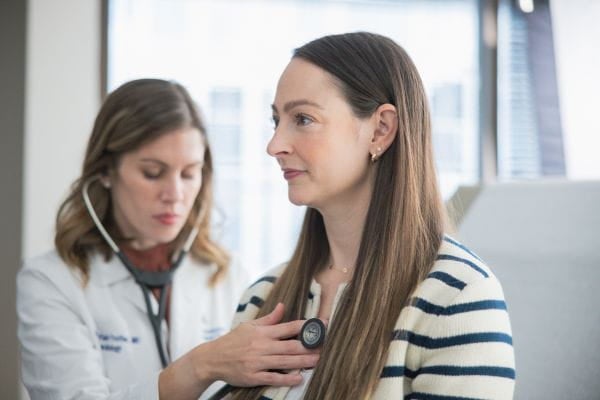
stethoscope

Our Chest Pain Center offers specialized urgent cardiac care within our hospital. You can receive care throughout our facilities if you are experiencing symptoms or through transfers from other facilities if you need advanced specialized treatment. Your cardiologist may also refer you to inpatient care for ongoing evaluation, treatment, and follow-up chest pain care.

Knowing the signs of a heart attack and where to go to get emergency care can be life-saving information. We help educate you on how to identify heart attack symptoms and what to do if you think you are having a heart attack.

If you are experiencing a life-threatening emergency, go directly to the ER or call 911.

All registered marks are property of their respective owners. All rights reserved.

Stories you'll love

Mom hugging her baby.

Young mother experiences AFib during pregnancy

January 28, 2026

At just 26 years old, a Nashville mother receives specialty heart care for women at Ascension Saint Thomas Heart Women’s Center during her second pregnancy.

Read more stories