Robotic single-port mastectomy care
Learn how robotic single-port mastectomy and coordinated breast reconstruction give select patients a new minimally invasive surgical option through multidisciplinary care at Ascension St. Vincent Fishers.
Knowing that you have options is one of the biggest reliefs when facing breast cancer or making the decision to reduce a high inherited risk for breast cancer. When navigating a difficult diagnosis and facing an important decision about your health, patients and their families deserve care that combines advanced technology with a compassionate, coordinated team of specialists.
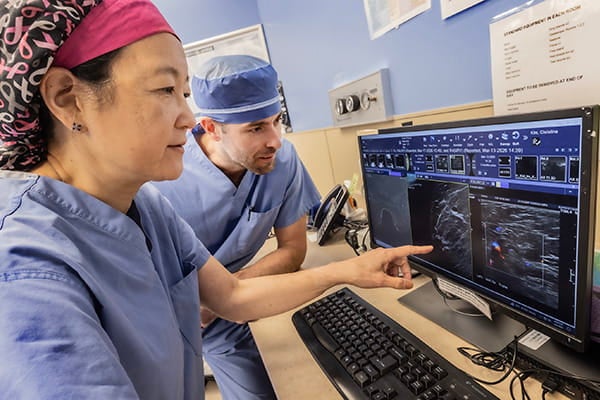
At Ascension St. Vincent in Fishers, breast surgical oncologist Christina J. Kim, MD, and plastic and reconstructive surgeon Ian C. Sando, MD, work together with nurses, physician assistants, anesthesiologists, surgical technologists and operating room staff to provide robotic single-port nipple-sparing mastectomy with immediate breast reconstruction for breast cancer patients.
The minimally invasive approach is designed to remove breast tissue through one small incision while preserving the breast skin and nipple when medically appropriate. Reconstruction is completed during the same operation, helping patients receive coordinated surgical care from one multidisciplinary team.
What is robotic single-port mastectomy?
For years, breast cancer patients only had the option of a traditional nipple-sparing mastectomy. This surgery typically requires a longer incision beneath the breast to remove breast tissue before reconstruction begins.
However, with robotic single-port surgery, Dr. Kim performs the procedure through one small incision that is hidden along the side of the breast near the bra line.
"The big difference between the traditional and robotic mastectomy is that the robotic technique is minimally invasive, with a hidden scar and less trauma to the tissue," Dr. Kim said. "So rather than making a big, 15 to 20 centimeter incision, we make a hidden scar incision that’s only about a three and a half centimeters."
Using high-definition visualization and robotic instruments, Dr. Kim removes the breast tissue through that single incision before Dr. Sando begins reconstruction.
Who may be a candidate?
Robotic single-port mastectomy is currently available for carefully selected patients.
According to Dr. Kim, ideal candidates today include many patients undergoing preventive mastectomy because of the inherited genetic risk. Other select patients have breast cancer where the tumor location and anatomy make the procedure work.
"So there are two patient populations that we can actually offer this to," Dr. Kim said. "It could be for breast cancer patients, or it can also be in the preventative setting where women have genetic mutations that make them at high risk for developing breast cancer."
As the team gains additional experience, more patients may become candidates for the procedure.
Reconstruction in one surgery
After the mastectomy is complete, Dr. Sando immediately begins breast reconstruction using the same incision. "After Dr. Kim has completed the robotic mastectomy with the patient still under anesthesia, I'll begin the reconstruction," Dr. Sando said.
Being able to have both surgeries done in one setting saves patients an additional surgery experience.
Currently, reconstruction typically involves tissue expanders, which are temporary adjustable implants or direct-to-implant reconstruction for patients who qualify for this treatment. "Reconstruction is performed utilizing the same incision used for the robot to avoid disrupting the soft tissue benefits that the robotic surgery is providing," Dr. Sando said.
Using the same incision may also help preserve healthy tissue needed for reconstruction as well as the need to have another incision.
Teamwork supports every patient
Robotic single-port mastectomy requires close collaboration before, during and after surgery.
"I really think the key is the team approach," Dr. Kim said. “I can't even emphasize enough how important teamwork is. We have an excellent team at Ascension Fishers Hospital that all trained extensively together from the very beginning and continue to make improvements.”
Dr. Sando says that teamwork extends well beyond the two surgeons.
"It's just not us, it's our nurses, it's our staff in the operating room. All that really plays a pivotal role in caring for patients and getting the best outcomes for them," Dr. Sando said.
This coordinated approach helps ensure every patient's treatment plan is developed with both cancer care and reconstruction in mind from the very beginning.
"I get Dr. Sando involved at the very beginning, because unless I know what the reconstructive plan is, I can't really offer them robotic surgery," Dr. Kim said.
Common questions about robotic surgery
One common misconception is that the robot performs the surgery independently.
"We're obviously in the room. We are in the operating room and present for the entire procedure," Dr. Kim said. "Everything that we do with the robot is really actually like our own actions."
Dr. Kim operates through the robotic arms and uses a very high definition camera that allows her to see. There is a surgical assistant at the bedside with the patient at all times.
Dr. Sando agreed, "The robot is really just an extension of Dr. Kim's hands and eyes. She's there in the room the whole time behind the console."
The robotic system gives surgeons enhanced visualization and precision while the surgical team remains in complete control throughout the procedure.
Recovery after robotic mastectomy
Patients currently return home the same day after robotic single-port mastectomy with reconstruction. Although every patient's recovery is different, both surgeons have been encouraged by their early experience.
"Compared to a traditional mastectomy, patients appear to recover faster after robotic mastectomies," Dr. Sando said.
Dr. Kim added, "With the less invasive approach, the incisions are smaller, hidden and allow quicker recovery.”
The team also uses regional anesthesia and pain management to help reduce discomfort after surgery. Dr. Sando explained that the anesthesiologist has a regime for perioperative pain control that uses different types of medication so that patients don’t require much narcotic pain medication after the procedure.
A new advanced treatment option for patients
Although the robotic program is still in its early stages, Dr. Kim says it gives eligible patients another surgical option they previously did not have.
"I just really am thrilled that we can actually offer patients a different better option that is minimally invasive with potential improved recovery, cosmesis and nerve sensation," she said.
One of the team's first patients underwent preventive surgery because of an inherited genetic mutation and has been pleased with both her recovery and reconstruction.
"She was very happy with her reconstruction," Dr. Kim said.
Know your options for breast cancer treatment
Every breast cancer diagnosis and every patient's risk factors are unique. That's why Dr. Kim encourages patients to learn about all available treatment options and work closely with their care team.
"I always tell patients that they should look at different options, research and really advocate for themselves," Dr. Kim said. "There are so many different options depending upon the situation."
Dr. Sando encourages patients to lean on those around them throughout treatment. "Lean on people close to you," he said. "The breast cancer community is huge."
At Ascension St. Vincent, patients have access to a multidisciplinary team that works together to develop a personalized treatment plan, combining advanced surgical technology with coordinated breast cancer care and reconstruction to help support you every step of the way.
To learn whether robotic single-port mastectomy may be an option for you, schedule a consultation with an Ascension St. Vincent Fishers breast care specialist.
Last updated: agosto 4, 2026