How Dell Children’s delivers critical care transport
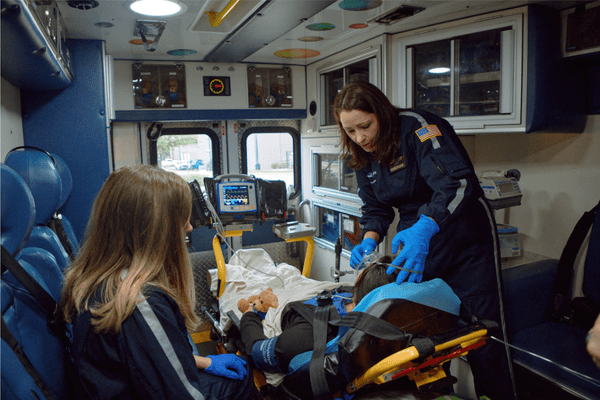
Dell Children's Transport Team delivers ICU-level pediatric and neonatal transport and emergency care for critically ill infants and children across Central Texas before they reach the hospital.
For some families, the hardest moments happen before they ever reach Dell Children’s Medical Center in Austin, Texas.
In an unfamiliar emergency room.
In a small rural facility.
In the quiet fear of not knowing what comes next.
That’s where the Dell Children’s Transport Team steps in.
“We see people on their worst day,” shared Amy Dore, Pediatric Transport RCP Interim Manager at Dell Children’s. “And we take pride in walking into that moment to bring some form of light, some form of hope… something that says everything’s going to be okay.”
Bringing the ICU to the patient
Unlike traditional emergency response, the Dell Children’s Transport Team specializes in interfacility transfers—bringing children from hospitals that may lack the resources to treat complex pediatric conditions.
Their role is not just to move patients.
It’s to stabilize, assess, and deliver ICU-level care before a child ever arrives at Dell Children’s Medical Center.
From newborns weighing less than a pound to critically ill children on life support, the team is equipped to manage every level of need.
In some cases, they are transporting children who require the highest level of intervention, including patients awaiting ECMO, where heart and lung function must be supported immediately to save their lives.
And they do it anywhere.
Across 46 counties in Central Texas.
By ground, helicopter or plane.
More than medicine
But what sets this team apart isn’t just clinical expertise.
It’s how they care.
“When we walk into a room, we’re not just treating the child—we’re treating the entire family,” Amy explained.
In those moments, parents are overwhelmed. Siblings are scared. Control feels lost.
So the team does something different.
They slow down.
They listen.
They bring parents into the process.
Sometimes that looks like inviting a parent to ride alongside their child in the ambulance.
“These are the things that change the experience,” Amy said. “It’s not just about getting them to the hospital. It’s about how they feel while we do it.”
And sometimes, it’s as small as a moment of distraction—a flashlight game borrowed from Child Life, where a child can “blow out” the light while their parent cannot.
The first experience of the Dell Children’s Difference
Long before a patient arrives on campus, they’ve already experienced Dell Children’s.
Through the transport team.
The same philosophy that defines care inside the hospital— the most complex care, compassion, and family-centered care—is carried into the field.
“We take everything we’ve learned inside Dell Children’s and bring it to the outside,” Amy shared.
That means:
- Advocating for families who feel unheard
- Recognizing subtle signs that other facilities may not see
- Creating calm in moments of chaos
- And helping to ensure every child arrives not just safely, but supported
Setting the standard in pediatric transport care
Every transport call is powered by a highly specialized team that includes a critical care nurse and a respiratory therapist.
Every role matters.
The nurse is looking at the full picture—monitoring every system in the body, anticipating changes, and helping to ensure nothing is missed. From medications to vital signs to overall stability, they are constantly assessing how to move the patient safely forward without causing harm.
Alongside them, the respiratory therapist brings deep expertise in the pulmonary and cardiovascular systems. Many of the children transported require complex respiratory support, and these specialists are trained to manage delicate equipment, adjust ventilation in real time, and respond instantly when breathing becomes compromised.
It’s a level of expertise many facilities simply don’t have access to.
And it’s one of the reasons the pediatric team recently achieved CAMTS (Commission on Accreditation of Medical and Transport Systems) accreditation, the gold standard for medical transport programs, without any deficiencies.
It’s a reflection of something the team already knows:
They are operating at a high level because their patients need them to.
Supporting families through critical moments
For many families, the transport experience becomes something they never forget.
Not because of the fear, but because of how they were cared for in it.
Because in a moment when everything felt uncertain, someone showed up with clarity, compassion and control.
And gave just enough of that control back.
“That’s what we’re trying to do,” Amy said. “They lose control the moment they walk into the emergency room. Our job is to give it back in whatever way we can.”
Learn more about Dell Children's Critical Care Transport Team and how they care for both patients and families in life’s most critical moments.
This blog is intended for general informational use. Any health-related information shared is not meant to provide or replace professional medical advice and does not establish a patient-provider relationship. If you are experiencing a medical emergency, call 911 or go to the nearest emergency room.
Last updated: julio 21, 2026