Dell Children’s food pantry supports families
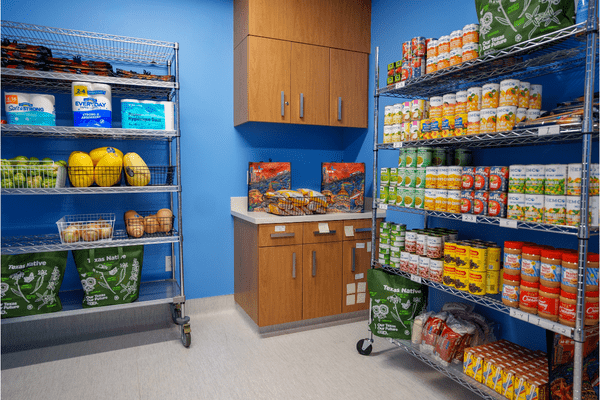
Dell Children’s recently opened a food pantry in the Children’s Blood and Cancer Center to help families experiencing food insecurity during cancer treatment in Central Texas.
When families walk through the doors of the Children’s Blood and Cancer Center (CBCC) at Dell Children’s Medical Center, they are often stepping into one of the hardest seasons of their lives.
There are appointments to keep. Diagnoses to process. Treatment plans to navigate.
And for many families, there is another reality quietly sitting in the background.
How they are going to put food on the table.
At Dell Children’s, that is not something families have to carry alone.
Inside the CBCC, a newly opened food pantry is helping bridge the gap between medical care and everyday needs by providing families access to healthy groceries during treatment. Through a partnership with the Central Texas Food Bank, families can select from fresh produce, pantry staples and other nutritious foods during clinic visits.
Any family that expresses a need is eligible, and after completing a brief intake form, can receive approximately 40 pounds of culturally appropriate and diet-sensitive groceries.
But for the social workers who helped bring the space to life, the pantry was never just about food.
It was about creating one less thing for families to worry about while caring for a child with cancer or a blood disorder.
Care that extends beyond the hospital room
For social workers Louise Howard and Mikayla Hutchins, support begins the moment a family enters the CBCC and continues throughout every stage of their journey.
The social work team follows hematology and oncology patients from their very first appointment through treatment and survivorship. Unlike many care teams that work solely in either the clinic or hospital setting, CBCC social workers continue supporting families across both spaces.
“We just kind of follow alongside them throughout their journey and hopefully try to help hold them up and support them along the way,” Louise shared.
That continuity allows the team to build long-term relationships with families and recognize needs that often extend far beyond a diagnosis.
“We are asking families to do really, really hard things,” Louise said. “And if they are worried about how they are going to get their next meal and how they are going to feed their kids, there is no space for them to do these really hard medical things.”
Food pantry provides choice, dignity and support
Inside the food pantry, families are welcomed into a space lined with shelves of pantry staples, fresh produce and reusable grocery bags waiting to be filled.
Rather than receiving pre-packed food boxes, families are able to select foods that best fit their needs.
Children often help choose what goes home with them, pointing out favorite snacks or foods they are excited to eat. Parents select meals that make sense for their family. And in a season where so much feels uncertain, the ability to make those choices matters.
“Allowing people to choose their own food is the best model,” Louise shared, explaining that it helps reduce waste while also preserving dignity.
That sense of dignity is one of the driving forces behind the pantry.
“There is a lot of shame around food insecurity,” Mikayla said. “When you can give someone a meal so they do not have to decide between buying their child’s medication or feeding their family, you give them more than food. You give them safety and security.”
For families spending long days in treatment, those moments of support create room to focus on what matters most — caring for their child, processing difficult conversations and simply making it through the day.
Food pantry connects families to lasting support
The pantry was made possible through a partnership with the Central Texas Food Bank and philanthropic support through Dell Children’s Foundation, including a generous donation from H-E-B.
Each week, hundreds of pounds of food move through the pantry and into the homes of CBCC families.
The program also connects families with additional resources, including SNAP benefit screening, reminders about the monthly mobile food FARMacy and ongoing support through the Central Texas Food Bank.
For the care teams involved, the goal is not simply providing groceries for today. It is helping families feel supported long after they leave the clinic.
It is also a reflection of the kind of care that defines Dell Children’s.
“One of the cool parts of our model is that families can select food that works best for their family,” Mikayla shared. “The kids are involved too. They are excited to pick things out and be part of the process.”
That process brings something many families lose during long-term treatment: a small sense of normalcy and control.
And sometimes, that can make all the difference.
Dell Children’s cares for the whole family
At its core, the food pantry represents something larger than food.
It is a reminder that healing does not only happen through medications, procedures or appointments.
Sometimes healing looks like a parent leaving a clinic appointment with groceries in hand.
Sometimes it looks like a child excitedly choosing peanut butter off a shelf.
And sometimes it looks like a family feeling seen beyond a diagnosis.
Because at Dell Children’s, caring for patients has always meant caring for the people who love them, too.
Last updated: julio 6, 2026