Pediatric scoliosis: signs, treatment and care
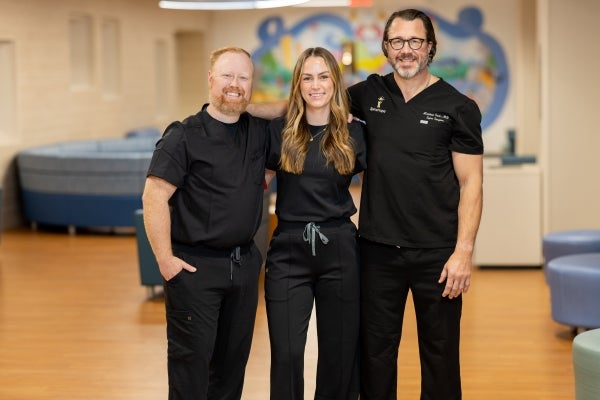
Pediatric spine specialists at Dell Children’s Medical Center in Austin, TX, share how early scoliosis detection expands treatment options and improves outcomes for children.
For many families, scoliosis begins with something subtle—a shoulder that sits slightly higher than the other, an uneven waistline or a concern raised during a routine screening.
What starts as a small observation can quickly lead to questions and uncertainty.
At Dell Children's, families facing a scoliosis diagnosis find more than specialized care. They find a team dedicated to helping children stay active, healthy and doing the things they love. Through one of the nation's leading pediatric orthopedic programs, children have access to a multidisciplinary team of scoliosis specialists, including pediatric spine surgeons Dr. Matthew Geck, Dr. Brian Kaufman and Dr. Kirsten Ross.
While every child's experience with scoliosis is different, the team agrees that one factor can make a significant difference in treatment options and outcomes: early detection.
"The earlier we identify scoliosis, the more treatment options we have and the better those treatments work," Dr. Geck said. "Whether that's bracing, growth modulation or surgery, early intervention gives children the best opportunity for a successful outcome."
Understanding scoliosis
Scoliosis is a condition that causes the spine to curve sideways, most often during periods of rapid growth. While some curves remain mild, others can continue to progress as a child grows.
Most children diagnosed with scoliosis have idiopathic scoliosis, meaning there is no known cause. Although scoliosis affects both boys and girls, adolescent idiopathic scoliosis is diagnosed more frequently in girls.
Because scoliosis often develops gradually, parents may not notice symptoms right away. Dr. Geck encourages families to watch for changes in posture and body alignment.
"Any asymmetry is worth discussing with your pediatrician," he said.
Common signs of scoliosis may include:
- Uneven shoulders
- A rib cage that appears more prominent on one side
- Uneven hips
- An uneven waistline
- Changes in posture or body alignment
One of the most important things for families to understand is that scoliosis often causes little to no pain. Many children feel completely normal, which is why routine screenings and awareness of early warning signs are so important.
The good news is that most children diagnosed with scoliosis will never require surgery. Many need only monitoring or bracing during periods of growth.
"The earlier we find it, the better chance we have of preventing a curve from becoming something that requires more significant treatment down the road," Dr. Geck said.
Personalized pediatric scoliosis treatment
No two cases of scoliosis are exactly alike, which is why specialists at Dell Children's work closely with families to develop treatment plans tailored to each child's needs, age, growth potential and long-term goals.
For Dr. Ross, that process begins with partnership.
"My role is to educate both parents and children so we can come up with a treatment plan together that is personalized to each family's goals because they know their child best," she said.
Depending on the severity and progression of a spinal curve, treatment may include observation, specialized bracing, growth-modulation procedures such as vertebral body tethering or surgical correction. The goal is always to provide the least invasive, most effective treatment while supporting healthy growth and development.
The future of scoliosis care
Dell Children's combines clinical expertise with advanced technology to deliver highly personalized care for children with scoliosis and other spinal conditions.
Families benefit from advanced imaging, sophisticated surgical planning and innovative surgical tools, including robotic-assisted spine surgery technology, that help physicians better understand complex spinal deformities and perform procedures with greater precision when surgery is needed.
These advancements allow the care team to tailor treatment plans to each child while continuing to improve outcomes and expand treatment options.
"The future of scoliosis care is increasingly focused on providing the right treatment for the right patient at the right time," Dr. Kaufman said. "Our ability to tailor treatment plans and intervene earlier than ever before is helping children stay active, healthy and doing the things they love."
For families, that means access to a full spectrum of care—from early monitoring and bracing to advanced surgical options—supported by a team dedicated to helping children thrive throughout childhood and adolescence.
Learn more about scoliosis care and pediatric spine care at Dell Children's.
This blog is intended for general informational use. Any health-related information shared is not meant to provide or replace professional medical advice and does not establish a patient-provider relationship. If you are experiencing a medical emergency, call 911 or go to the nearest emergency room.
Last updated: junio 25, 2026