Austin stroke survivor finds hope at Dell Seton
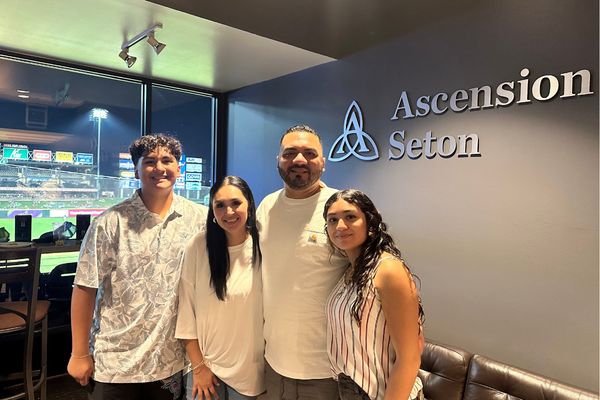
After a stroke in July 2024, David Hurtado received advanced neurocritical care at Dell Seton Medical Center at The University of Texas in Austin, Texas.
For David Hurtado, July 25, 2024, started like many busy days before it. A husband, father and construction project manager, David was used to long hours, constant movement and pushing through discomfort. Earlier that week, he had heard what sounded like a “pop” while taking a shower. A severe headache followed, but he kept working, driving and showing up for his family.
A few days later, the pain had become impossible to ignore.
David and his family were on their way to see a movie when he stopped for medicine, hoping it would help. During the movie, his wife, Lily, noticed something was wrong. David, who usually enjoyed the previews and popcorn, had barely touched anything. After the movie, he stood up slowly and realized his left side felt heavy.
“I walked past the restroom and said, ‘Take me to the hospital,’” David said. “Then I told my son, ‘Help me walk. I can’t walk anymore.’”
Lily drove him across the street to the emergency room at Ascension Seton Cedar Park. Soon after, scans showed David had bleeding in his brain. David was transported to Dell Seton Medical Center at The University of Texas, home to the only dedicated neurocritical care unit in Central Texas.
Specialized stroke care when every second counts
There, they met with neuroendovascular surgeon, Jeff Miley, MD. Dr. Miley treated the bleeding and repaired the arteriovenous malformation or AVM, an abnormal connection between arteries and veins in the brain.
“Not all strokes are the same,” Dr. Miley said. “David’s condition was recognized early, and advances in technology allowed us to help him and achieve a cure. But survival and quality of life afterward also depend on the care in the ICU. This was not a one-person success. It was the success of an entire team.”
Finding strength through recovery and rehabilitation
When David woke up, he could not move the left side of his body. Speaking was difficult, writing was difficult, even using his phone felt impossible. For someone who had spent his life being active — swimming, playing varsity baseball, completing triathlons and working in construction — the change was overwhelming.
“I’ve always been the guy who is busy, always doing something,” David said. “It was frustrating. I couldn’t move my left side. I couldn’t talk the way I wanted to. I couldn’t write.”
Still, David’s personality came through. Family, friends, coworkers and church community members filled his room with support. Even from his hospital bed, David tried to make others laugh.
“I didn’t want people to look at me with sadness,” he said. “I wanted them to know I was alive, I was in good spirits, and I was going to keep going.”
David credits his wife, Lily, with staying by his side throughout his hospitalization and recovery. He also remembers the nurses and care teams who cared for him and his family with compassion.
“I don’t have the words to explain the way they made me and my family feel,” David said. “They were amazing. I wish I could go back and hug every single one of them.”
After his time at Dell Seton, David continued his recovery. With support from an Ascension Seton grant, he later transferred to an inpatient rehabilitation focused on neurological recovery.
Small milestones that led to big progress
His progress came one small movement at a time.
“For weeks, I couldn’t move my left side,” David said. “Then I moved my thumb maybe half an inch. Everybody was rejoicing. It was a long road, but I kept telling myself to take one step at a time.”
Dr. Miley said David’s determination and family support played an important role in his recovery.
“I tell patients they have two choices after a stroke,” Dr. Miley said. “You can dwell on what happened, or you can work hard and make a great story out of it. David has worked hard to make a great story.”
David returned home on September 13, 2024. Two days later, Ascension Seton helped celebrate him and his family at a Round Rock Express game. For David, the moment represented more than a night at the ballpark. It was a chance to celebrate life, family and the care that helped him move forward.
Gratitude, faith and hope after a stroke
Today, David is back at work and continuing to recover approaches each day with gratitude, humor and faith.
For David, sharing his story is a way to honor the people who cared for him and encourage others to pay attention to stroke symptoms.
“I’m thankful for my wife, my kids, my family, Dr. Miley, the nurses, the therapists — everyone,” David said. “I know I had somebody watching over me.”
Ascension Seton is committed to advancing stroke care, improving outcomes and serving as a trusted provider across Central Texas. Learn more about care at the Seton Brain and Spine Institute.
If you or a loved one is experiencing warning signs of a stroke such as numbness, confusion, trouble speaking, dizziness or loss of balance, every second counts. It's important to call 911 and go to the nearest emergency room right away.
Last updated: mayo 18, 2026