Nonsurgical thyroid care at Ascension Seton Hays
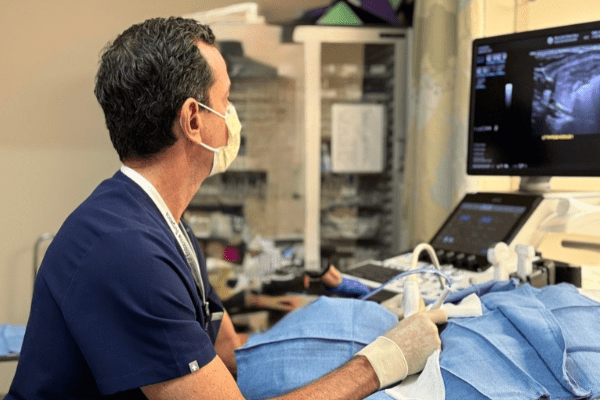
Ascension Seton Hays in Kyle, Texas, now offers ultrasound-guided radiofrequency ablation for eligible benign thyroid nodules performed by general surgeon John Sabra, MD.
If you have a thyroid nodule that's growing or causing discomfort, you may have treatment options that don't require surgery.
John Sabra, MD, a general surgeon with Ascension Medical Group Seton Surgery in Austin and Kyle, Texas, offers radiofrequency ablation (RFA), a nonsurgical procedure that uses heat to shrink certain thyroid nodules.
RFA may be an option if your thyroid nodule is benign (not cancerous) and is causing symptoms or changes in the appearance of your neck.
What is radiofrequency ablation (RFA)?
Radiofrequency ablation, or RFA, is a procedure that uses heat to shrink thyroid nodules without surgery.
“RFA stands for radiofrequency ablation, and it treats thyroid nodules,” said Dr. Sabra.
During the procedure, Dr. Sabra uses ultrasound imaging to guide a thin probe into the thyroid nodule. The probe delivers energy that heats the targeted tissue, helping the nodule gradually shrink over time.
Thyroid nodules are common, especially as you get older. Most are benign, meaning they are not cancerous.
While many thyroid nodules don't need treatment, it's important to have a new or changing nodule checked by a doctor. Your care team may recommend an ultrasound, a biopsy or other tests to better understand the nodule and your treatment options.
When does a thyroid nodule need treatment?
Many thyroid nodules don't cause symptoms and only need regular monitoring. But as a nodule grows, you may notice:
- A feeling of fullness or pressure in your neck
- Difficulty swallowing
- A visible lump or change in the appearance of your neck
- Discomfort related to the size of the nodule
If your thyroid nodule is causing symptoms, treatment may help.
“A good candidate for RFA is the typical patient who wants to avoid surgery but has a nodule that’s large enough to start causing symptoms or is unsightly,” said Dr. Sabra.
RFA may be an option if you have a benign thyroid nodule and want to avoid surgery. However, it's not the best choice for everyone.
Dr. Sabra reviews your medical history, imaging and biopsy results. He also performs an ultrasound to help determine whether monitoring, RFA or surgery may be appropriate for you.
What to expect during thyroid RFA
If you're considering RFA, knowing what to expect can help you prepare.
Before the procedure, Dr. Sabra evaluates your thyroid nodule. A fine-needle aspiration (FNA) biopsy is necessary to confirm that the nodule is benign, if you have not already had one.
“I tell patients that radiofrequency ablation is just a different version of that same thing,” said Dr. Sabra, referring to the experience of having an ultrasound-guided biopsy.
During the procedure, you remain awake while Dr. Sabra uses ultrasound to guide the probe into the nodule. The probe delivers heat to the targeted tissue.
“They’re wide awake,” said Dr. Sabra. “It’s a 30-minute-or-so procedure, home the same day, and back to work the next day if they like.”
The procedure typically takes about 30 minutes, although your total visit may be longer. Many patients return home the same day and your recovery time will depend on your individual needs.
How much does a thyroid nodule shrink after RFA?
RFA is designed to shrink a thyroid nodule, not remove it completely.
“Ablation doesn’t get rid of the nodule completely,” said Dr. Sabra. “It shrinks it.”
The goal of treatment is often to reduce the nodule's volume by at least 50%. Some nodules may shrink more, while others may need additional treatment.
Because nodules shrink gradually, your care team will schedule follow-up ultrasounds to monitor changes over time.
What are the potential benefits of thyroid RFA?
For some patients, RFA may offer an alternative to thyroid surgery.
Potential benefits include:
- No large surgical incision: RFA uses a small needle entry point, which may help you avoid a visible neck scar.
- Shorter recovery: Some patients may be able to return to their usual activities sooner than they would after surgery.
- Preservation of healthy thyroid tissue: RFA targets the nodule while aiming to preserve surrounding thyroid tissue, which may reduce the need for thyroid hormone replacement.
- Outpatient treatment: Patients go home the same day.
“There’s no scar,” said Dr. Sabra. “There’s just a tiny little nick where the needle went in.”
Every patient is different, and results can vary. Dr. Sabra will discuss the potential benefits, risks and other treatment options to help you make an informed decision.
Surgery may still be recommended if your nodule is very large, cancer is suspected or surgery is a better option for your individual needs.
Personalized treatment options for thyroid nodules
There's no single treatment that's right for every thyroid nodule.
At Ascension Medical Group Seton Surgery, Dr. Sabra offers several options for thyroid nodule care, including:
- Ultrasound monitoring: Watching the nodule over time to check for changes
- Thyroid biopsy: Taking a small tissue sample to help determine whether a nodule is benign
- Radiofrequency ablation: Using heat to shrink certain benign nodules
- Thyroid surgery: Removing part or all of the thyroid when surgery is recommended
“I want to offer patients absolutely the full spectrum,” said Dr. Sabra.
With more than 20 years of surgical experience, Dr. Sabra focuses on thyroid and parathyroid conditions. His approach focuses on helping patients understand their options and choose a treatment plan that fits their needs.
“What makes me unique is I can offer any of those to a patient, and I’m not trying to push the patient toward any one decision,” said Dr. Sabra. “I want what’s best for them.”
Find out if thyroid RFA is an option for you
If you have a thyroid nodule that's growing, causing discomfort or changing the appearance of your neck, talking with a doctor can help you understand your next steps.
Dr. Sabra sees patients at his clinic locations in Southwest Austin and Kyle, Texas. During your visit, he can review your medical history, perform an ultrasound and discuss whether monitoring, RFA or surgery may be an option.
“Patients need to go somewhere where they have all the options offered to them,” said Dr. Sabra. “They should never feel forced to do any one particular thing.”
Schedule an appointment with Dr. Sabra to learn more about your thyroid nodule treatment options.
This information is for educational purposes only and is not a substitute for medical advice, diagnosis or treatment. Talk with your care team about your individual condition and treatment options.
Next steps and helpful resources
Dr. Sabra is a board-certified general surgeon at Ascension Medical Group Seton Surgery, specializing in the diagnosis and treatment of thyroid and parathyroid disorders, in Kyle and Austin, Texas.
Talk to a doctor about your symptoms. Find primary care in your area.
Learn more about Ascension Medical Group Seton Surgery.
Last updated: November 12, 2026