Back to being Noah: One year after an AML diagnosis
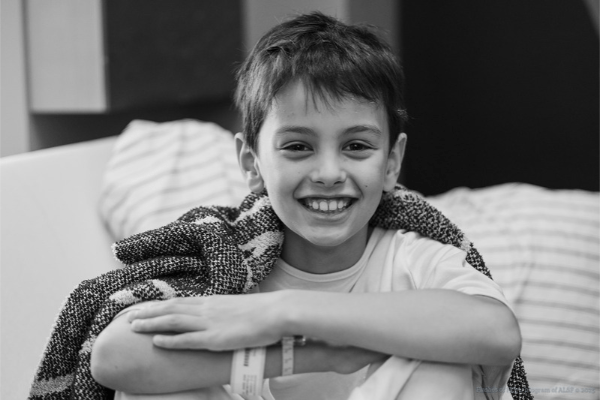
One year after an acute myeloid leukemia diagnosis, 11-year-old Noah is back to school, sports and everyday life after completing treatment at Peyton Manning Children’s Hospital in Indianapolis
At 11 years old, Noah has a lot to keep him busy. He runs cross-country, bikes, likes taking things apart and putting them back together, reads, plays video games and, according to his parents, has never been particularly interested in sitting still.
“He’s curious,” his dad, David, said. “He’s funny, he’s smart, he is active.”
That description sounds a lot like the Noah his family knew before September 2025, when he was diagnosed with acute myeloid leukemia (AML). A year later, after five intensive rounds of chemotherapy and months spent in and out of Peyton Manning Children’s Hospital, it sounds a lot like Noah today, again.
Noah's mom, Mayumi, describes the first signs that something was wrong as subtle. They had spent the summer in Japan, where he even attended school. After returning home to Indiana and starting the new school year, Noah developed a fever and seemed unusually tired. The fever went away, but the fatigue didn’t.
For a kid whose parents usually struggled to get him to sit still long enough to fall asleep, they were experiencing the opposite. He was also having trouble keeping up with cross-country. Then, while playing basketball with his dad, Noah suddenly became dizzy and needed to go inside.
“Something’s definitely wrong,” David remembers thinking.
Mayumi scheduled an appointment with Noah’s pediatrician and pushed for bloodwork. A few days later, the family received a call telling them to take Noah to the emergency department at Peyton Manning Children’s Hospital.
Tests showed significant abnormalities in his blood counts. Within days, the family learned Noah had AML. What followed moved quickly.
Noah received blood and platelet transfusions, underwent additional testing and soon began chemotherapy. Over the months that followed, he completed five intensive rounds of treatment. His family remembers stretches when his blood counts were so low that he spent weeks at a time isolated in his hospital room.
For Noah’s parents, the beginning was filled with unknowns.
“The first week felt like a month,” Mayumi says.
There were doctors, tests, treatment decisions and new medical terminology to understand, all while the family was trying to process what was happening to their son. David remembers that first round as particularly difficult.
“You don’t know at all what’s coming,” he said. “You don’t know what to think.” Eventually, the family settled into what David described as a “new normal.” Routines helped. So did having people around them who could answer questions, explain what was happening and listen.
At Peyton Manning Children’s Hospital, Noah’s care extended beyond chemotherapy. His family worked with nurses, nurse practitioners, palliative care specialists, Child Life specialists and hospital teachers throughout his treatment. Those relationships became especially important when the amount of new medical information felt overwhelming.
Throughout Noah’s treatment, his oncologist, Dr. Bassem Razzouk, nurse practitioners and oncology nurses worked together to answer the family’s questions, explain what to expect and help ease some of the uncertainty that came with his diagnosis and treatment.
For David, having access to people with experience caring for children with cancer helped bring some sense of understanding to a situation the family couldn't control. "More information from people that have been through this kind of thing gives you comfort and confidence."
And then there was Noah himself.
Cancer treatment meant spending long stretches inside a hospital room, sometimes 30 to 40 days at a time. But Noah found ways to fill those days.
Video games, TV, drawing, toys, art and music therapy. He finished a seven-book series. He connected with his younger brother, Micah, through video calls and games. He also formed relationships with the people caring for him.
Noah remembers his nurse, Lydia, fondly, especially since they shared an interest in the same books. His parents remember nurses stopping by to say hello or play a game. Some left jokes, riddles or drawings for Noah to find in the morning.
“They made Noah happy,” Mayumi said. “Those kinds of things that they don’t really have to do, but they come and do it.” Those small gestures stayed with her. “I just loved the atmosphere that they made for Noah.”
Child Life specialists helped make the hospital feel more like a place where Noah could still be a kid, too. Activities, special visitors and moments broke up the long days of treatment.
For families receiving pediatric cancer care at Peyton Manning Children’s Hospital, the Child Life and Healing Arts team, teachers and other members of the multidisciplinary care team work alongside physicians and nurses to support children and families throughout treatment.
While Noah was in the hospital, life outside of it continued. His younger brother still had school, swimming and friends. David and Mayumi worked hard to keep his routine as normal as possible. When it came time to explain what was happening to Micah, Child Life specialists helped David and Mayumi explain leukemia and Noah’s treatment in language he could understand.
“We had to explain that he was old enough to know what leukemia was,” Mayumi said. “But we weren’t sure how to word it so that a child of that age could understand it and not fear.”
Noah also stayed connected to school during treatment. A hospital teacher coordinated with his school, and when he was able, Noah participated in lessons with his regular class. The goal was to help Noah remain connected to his life outside the hospital while giving him the space he needed to get through treatment.
Through it all, David and Mayumi saw something in their son they hadn't fully known was there. They saw how strong he could be.
David remembers one morning during treatment when Noah had lost weight, and his hair was falling out. Noah looked at himself in the bathroom mirror and told himself, “I can do this."
“Until a kid is faced with something, you don’t really know how they’re gonna react,” he said. “I remember thinking, 'How are you so strong through this?'”
Today, Noah is done with treatment and returns for follow-up care. And much of his life looks wonderfully ordinary again. There is school, biking and cross-country. Things to build and things to take apart. There is a younger brother to play video games with and still plenty of energy.
After everything their family experienced over the past year, seeing Noah cross the finish line at his recent 3K reminded them how far he has come. For his parents, that brings gratitude, and so does the support of the people who helped their family get here.
Last updated: November 17, 2026