Adult scoliosis care in Central Texas
Ascension Texas Spine & Scoliosis specialists in Austin provide adult scoliosis care, helping patients understand symptoms, treatment options and next steps.
June is Scoliosis Awareness Month and Ascension Texas Spine & Scoliosis specialists in Austin, Texas, help adults understand scoliosis symptoms, treatment options and when to seek expert care.
Scoliosis is often thought of as a condition that only affects children and teens. But adults can have scoliosis too — and for many, symptoms may not appear or worsen until later in life.
“Adults can have scoliosis,” said Rory Mayer, MD, neurosurgeon with Ascension Texas Spine & Scoliosis and Director of Neurosurgical Spinal Deformity Service. “Some had scoliosis as a child and never had surgery. Others had surgery when they were younger and develop new problems as they get older. And many adults develop scoliosis later in life.”
In fact, Dr. Mayer notes that approximately 30% of adults over age 65 have some degree of scoliosis. While not everyone requires treatment, many benefit from evaluation and ongoing management by specialists experienced in spinal deformity.
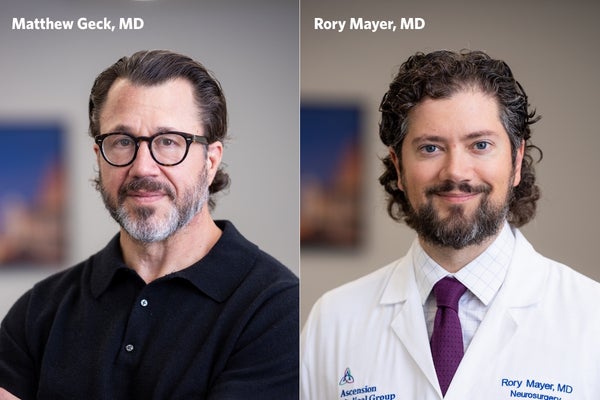
During Scoliosis Awareness Month, Dr. Mayer and Matthew Geck, MD, orthopedic spine surgeon and co-chief of Ascension Texas Spine & Scoliosis, want adults to know that back pain, leg pain, posture changes and mobility challenges are not symptoms they simply have to accept as part of aging.
"Our commitment extends beyond pediatric care – we support young patients as they transition into adulthood and lead fulfilling lives,” said Dr. Geck. "Whether it's a brace, growth modulation like vertebral body tethering, or surgery—everything is better earlier."
When to seek care for adult scoliosis
Adults should consider seeing a spine specialist if they notice:
- Changes in posture
- Difficulty standing or walking for long periods
- Feeling off balance, stooped forward or like they are falling forward
- New numbness, weakness or trouble walking
- Pain that limits daily activities
- Significant back pain or leg pain
For some adults, scoliosis progresses slowly over time. For others, pain, nerve compression and changes in spinal alignment can begin affecting everyday activities, independence and overall quality of life.
Dr. Geck, who has practiced spine surgery in Austin for more than 24 years, encourages adults not to ignore symptoms simply because they've lived with them for years.
“Treating scoliosis is like planting an oak tree,” Dr. Geck said. “The best time to take care of it was 20 years ago. The second-best time is right now.”
Many adults who were diagnosed with scoliosis as teenagers assume their condition has remained unchanged. However, spinal curves can continue to progress throughout adulthood, leading to worsening pain, imbalance and degeneration over time.
"Even after skeletal maturity, scoliosis can continue to progress, which is why long-term follow-up matters," said Dr. Geck.
Nonsurgical treatment for adult scoliosis
At Ascension Texas Spine & Scoliosis, the philosophy is conservative care first. According to Dr. Mayer, roughly 90% of patients who come to the clinic never require surgery.
Care plans may include physical therapy, evaluation by physical medicine and rehabilitation specialists, injections and other nonsurgical treatment options designed to reduce pain and improve function.
“Even for people where we don't recommend surgery right now, it's good to have established care,” Dr. Mayer said. “If something changes over time, we have a very good reference point.”
Having an experienced team monitor scoliosis can help patients understand whether their condition is stable or progressing and determine when additional treatment may be appropriate.
When surgery may be needed for scoliosis
While most patients respond well to conservative treatment, surgery may be recommended when scoliosis causes significant curve progression, neurologic symptoms or severe pain that limits daily life.
According to Dr. Mayer, three common reasons adults move into a surgical treatment pathway include:
- New weakness, numbness or difficulty walking
- Severe pain that affects mobility and daily activities
- Significant progression of the spinal curve
For many adults, the idea of scoliosis surgery may be tied to outdated perceptions of lengthy recoveries and unpredictable outcomes.
“Traditionally, scoliosis surgery had a reputation for being a very large operation with a difficult recovery,” Dr. Mayer said. “Today, the technology and planning available to us have dramatically changed what we're able to do.”
Advances in scoliosis surgery and care
Advancements in imaging, surgical planning and patient-specific technology have transformed scoliosis care over the last decade.
Dr. Mayer explained that surgeons now use advanced computer-guided planning to evaluate each patient's spinal alignment and predict surgical outcomes with a high degree of accuracy before entering the operating room. Patient-specific rods, implants and cages can be designed around an individual's anatomy and spinal deformity.
Dr. Geck has witnessed these advancements firsthand throughout his more than two decades in practice.
“We've become dramatically better at understanding spinal alignment and planning surgery,” Dr. Geck said. “The ability to personalize treatment and predict outcomes has improved significantly.”
These innovations have helped make scoliosis surgery safer and more predictable than ever before, giving patients greater confidence in their treatment options and recovery expectations.
A multidisciplinary approach to scoliosis care
Ascension Texas Spine & Scoliosis is the only comprehensive scoliosis center in Central Texas that brings together orthopedic spine surgery, neurosurgery, physical medicine and rehabilitation, physical therapy and nonsurgical spine care under one program.
For complex scoliosis cases, surgeons frequently work together using a co-surgery model. Dr. Geck and Dr. Mayer often collaborate on procedures, an approach that research has shown can help reduce complications and improve patient outcomes.
This team-based model also helps patients avoid fragmented care. Too often, adults with scoliosis undergo treatments focused on a single symptom rather than receiving a comprehensive evaluation of the underlying spinal deformity.
"I learn from every child that I've ever treated as I follow them into their 20s, 30s, and 40s,” Dr. Geck said.
“Our goal is to understand the whole problem,” Dr. Mayer said. “Then we can guide patients toward the treatment option that is most likely to help them.”
Don't wait to seek scoliosis care
One of the most important messages of Scoliosis Awareness Month is that adults living with scoliosis symptoms have options.
Whether symptoms started recently or have been present for years, today's treatments can help many patients improve mobility, reduce pain and regain quality of life.
"The future is moving from a two-dimensional understanding of scoliosis to a three-dimensional understanding—and that's going to change everything,” Dr. Geck said.
“There's a possibility of helping even very advanced problems,” Dr. Mayer said. “The first step is getting connected to our clinic so we can perform a thorough evaluation and discuss what's realistically possible.”
Schedule an adult scoliosis evaluation
If back pain, posture changes or mobility challenges are affecting your daily life, the spine specialists at Ascension Texas Spine & Scoliosis are here to help. Schedule an appointment today to learn more about your options and receive personalized adult scoliosis care close to home.
Last updated: June 22, 2026