Technology advancement for stroke survivors in Wichita
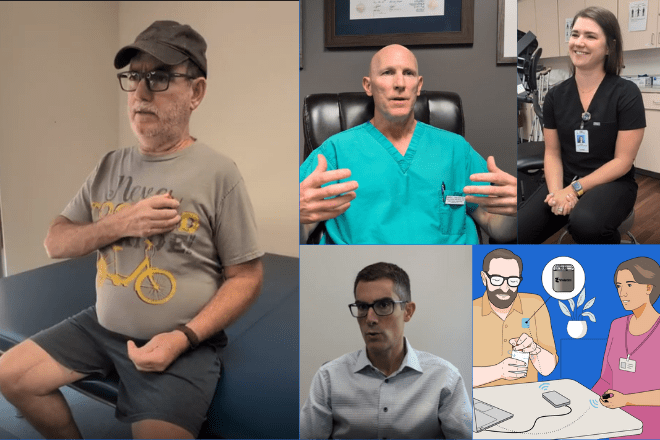
Ascension Via Christi St. Francis in Wichita, Kansas is the first hospital in the region that offers a new therapy for stroke survivors.
Recovering from a stroke can be an intense physical, mental, and emotional recovery. The biggest goal many survivors have is to regain movement and function but sometimes they hit a point where progress slows down or stops. At Ascension Via Christi St. Francis in Wichita, Kansas, a new therapy is giving people hope again.
Via Christi’s neurologists and therapists are using an innovative treatment called Vivistim® System, a small implanted device that helps the brain relearn movement. For patients like Gary Smith, it has been life‑changing.
Gary Smith was the first stroke survivor in Wichita and at Via Christi St. Francis to receive the Vivistim® implant. Before the therapy, he struggled with even the simplest tasks.
He explained, “My function when I started was I couldn’t do anything.”
After his stroke, Gary couldn’t open his hand, button a shirt, or hold everyday items. Vivistim® gave him a new chance to regain independence.
New therapy that returns brain function
Vivistim® works by stimulating the vagus nerve, which helps the brain form new pathways, which is a process called neuroplasticity.
Jim Walker, MD, medical director of the Via Christi Comprehensive Stroke Center, describes it this way: “Vivistim® is finally giving us—and when I say us, I actually mean stroke survivors—a therapeutic option for rehabilitation that has a significant impact on quality of life and improvement after stroke.”
Occupational therapist Ashley Thomas says it’s helping return brain functions.
“It’s just a small surgically implanted device that is connected to and electrically stimulates the vagus nerve. The vagus nerve is actually the longest cranial nerve in the body,” said Ashley. “We get to trigger that electrical stimulation and hopefully promote more neural pathways to improve that function in the arm. In stroke recovery, we’re really focusing on that neuroplasticity connection between the brain and the affected limb.”
First to offer stroke therapy in Wichita
Chad Ammar, MD, medical director of Via Christi Vascular Surgery, performed Gary’s outpatient procedure.
“We’re the first site here locally to do this operation and to have this technology available,” said Dr. Ammar.
“This is an outpatient procedure where there’s two incisions,” he said. “One is along the neck and the second one is below the collarbone. The operation takes about 45 minutes. They can expect a pretty short recovery, a little bit of discomfort for a day or two.”
Gary’s recovery from the procedure was minimal.
“Went home the same day,” he said. “Got it done in the morning, and by supper, I was home. It was in and out.”
Recovery with occupational and physical therapy
Two weeks after surgery, patients begin a six‑week therapy program that pairs exercises with Vivistim® stimulation.
“It’s a pretty intense regimen,” said Ashley. “We see them six weeks, three times a week for an hour‑and‑a‑half session each time. It’s very intense. Quite a bit more intense than regular therapy for sure.”
Occupational therapist Angela Hull explains how the device works during therapy.
“We’re just using this device to talk to your Vivistim® implant that’s stimulating your vagus nerve at key points during our activity to help your brain pay attention and build new nerve connections.”
Gary felt the challenge, too.
“My therapy’s been good. An hour and a half’s a pretty long time. My brain’s tired at the end.”
After the clinic sessions, patients continue therapy at home for up to four hours a day using a simple magnet.
“The implant’s here in my chest, and you basically just swipe twice and it turns it on,” said Gary. “It just kind of helps you do things. It’s not like magic, but just to do stuff helps.”
Evidence and improvements for stroke outcomes
Dr. Walker emphasizes that this simple device has helped patients reach beyond the potential of their limited capacity following a stroke or other neurological impairment.
“We’ve got one patient who thought he had plateaued. He went through therapy with Vivistim® in place and is now able to go fishing again, use his arm to fish, hold an ice cream cone, button a shirt. And the level of independence that can be regained is just something remarkable we haven’t seen for a long time.”
Gary experienced similar breakthroughs.
“Now I can open my hand, I can button pants, I can button shirts,” he said. “Just all the little things you don’t really think about until you can’t do it.”
He celebrated a big milestone from his treatment, a thing most of us take for granted.
“Holding ice cream, holding an ice cream cone and using a spoon,” said Gary. “That’s something I couldn’t do before… It was probably a thrill just being able to hold it.”
Improving survivors’ life in Kansas
Ashley said this therapy is especially important for Wichita and the surrounding region.
“Wichita tends to be the area that treats all of Western Kansas. Having something so accessible and new for chronic stroke survivors is a big, big deal,” she said.
Dr. Walker is excited about the potential for patients as they recover.
“Vivistim® is the first therapy we’ve had in probably 20 years that provides stroke survivors an ability to see a significant improvement in neurologic function,” he said. “It’s fantastic what we can do for the survivors of stroke here.”
Gary encourages patients to consider what these kinds of advancements can do for their recovery.
“I would tell them to go for it,” he said. “It’s kind of been a blessing. I don’t know that I’d be able to do what I can do now without it.”
Learn more about stroke rehabilitation in Wichita
Ascension Via Christi St. Francis offers comprehensive advanced heart, vascular and neurological care, stroke treatment, and rehabilitation services for patients across Kansas.
If you or a loved one is experiencing warning signs of a stroke such as numbness, confusion, trouble speaking, dizziness or loss of balance, every second counts. It's important to call 911 and go to the nearest emergency room right away.
All third party trademarks are property of their respective owners. All rights reserved.
Last updated: abril 13, 2026